
Lowell growing fast as small-town feel draws newcomers
Lowell is a small town with room to grow, and developers have taken notice. The town now has nine residential tax increment financing districts, more than any other in Northwest Indiana.
“We’re doing 200-plus homes a year now in town here,” Town Manager Craig Hendrix said. “For a small town, we’ve never seen this before.”
“The nice thing about Lowell is we’ve always been able to grow in all directions,” Director of Planning and Development Richard Oman said. He’s a man of many hats for the town. He’s also director of public works and the utilities superintendent.
Lowell has an advantage over other municipalities in northern Lake County. It’s not a landlocked community, so annexation is still an option.
The last eight to 10 years, Oman said, the town has seen a big boom in residential developments.
“We’re able to accommodate it because plans showed where the town could expand, out to the borders,” he said.
The town grew from 5,827 residents in 1980 to an estimated 11,449 in 2025, nearly doubling in size.
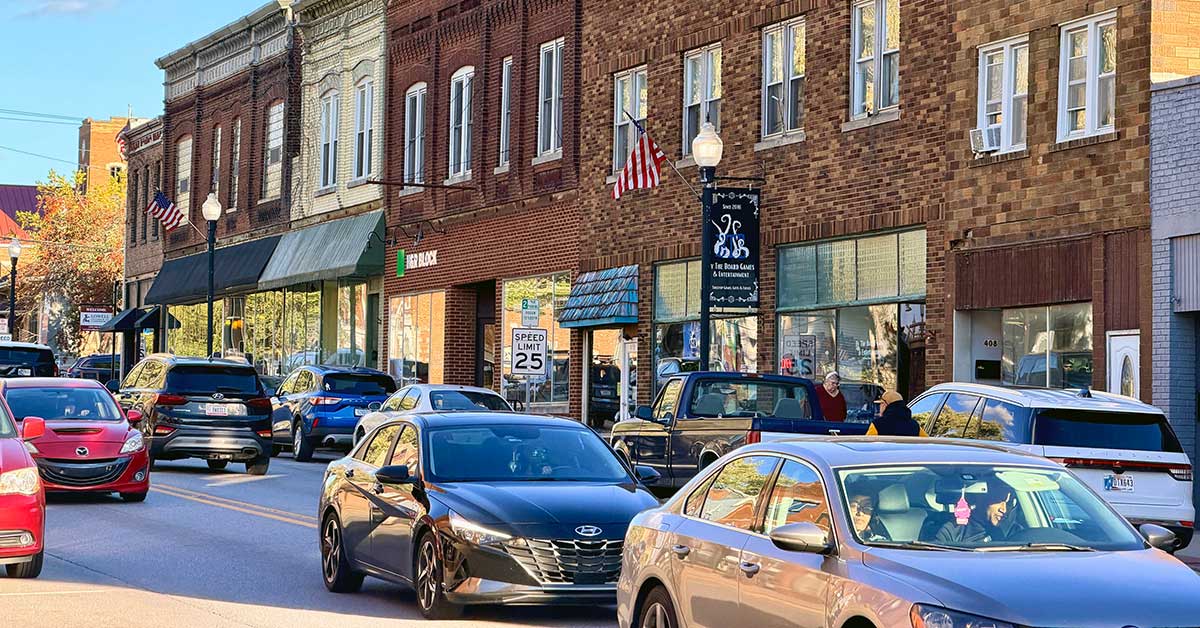
Even as the population grows, the downtown keeps its small-town feel.
“It starts with your history and your historic part of the town, downtown,” Oman said.
To Hendrix, the downtown is key to maintaining Lowell’s small-growth character. “We’ve been trying to hold the downtown,” he said, spending money on roads, sidewalks and other improvements there.
“You keep the downtown looking like a downtown. We have historic standards and guidelines we stick by,” he said.
Oman oversees the facade grants program, which is active.
Downtown character
Lowell resident Ryan Thiele, chief operating officer for VIA Marketing in Merrillville, spent a few years on the town’s Plan Commission and Board of Zoning Appeals. “Downtown has a very historic feeling,” he said, with brick facades and buildings that date to the late 1800s or early 1900s.
Vacant storefronts aren’t a problem, Hendrix said. When one shop closes, another quickly takes its place.
That’s not to say that all buildings are kept up, of course. That’s where the town steps in, buying buildings that aren’t maintained and razing them to prepare the site for new opportunities. “We never condemn. We buy them as they become available,” Hendrix said.
Park and Recreation Director Cyndi Hughes is also a Lowell Chamber of Commerce board member. She agrees with the need to get more people to pay attention to the downtown area.
“We have a historic downtown area that has a lot of turnover,” she said.
Wearing her parks hat, she’s keen to lure people downtown to explore the shops.
That involves events like trick-or-treating when parents can discover shops they didn’t realize were there. The park department now runs the Labor Day parade, the largest and longest running in Northwest Indiana. The parade, which marked its 106th year in 2025, was joined by a kiddie parade that weekend, too.
“I think it’s really good exposure for those businesses,” Hughes said. “Those local businesses are really important in our community.”
Help from parks
The new $12 million Nassau Park will open soon, bringing further foot traffic downtown. The grand opening is likely to be held in July, after the landscaping work is done.
Hughes credited the Dean and Barbara White Family Foundation for a $5 million grant that will go a long way toward developing the park.
“We’re going to have a gathering room; it’s going to hold about 115 people,” she said, with the new community center. The parks department will be housed there, and indoor programming and meetings will be offered. The building was a former dance studio, but the dance floor has been removed, so Hughes won’t be waltzing her way around the building.
Outside, there will be a splash pad, amphitheater, large playground and more.
It’s not the only park in town, either.
Evergreen Park, on Commercial Avenue, is the largest town park. A fishing pond is among its attractions.
Freedom Park is owned by three entities, the town along with West Creek and Cedar Creek townships. Its 116 acres include soccer fields, pickleball courts, a milelong paved trail and disc golf course.
“It’s really an underutilized park,” Hughes said.
A sled hill will be nice there, after scrounging dirt to build it up, she said. Hughes raised her kids in Lowell, and there wasn’t a good place to go sledding. She’ll be tempted to use the new hill herself.
“In the winter, there was nothing to do,” she said. The hill was seeded in October, so perhaps it will be ready for winter use.
Hughes is seeing more usage in the town’s parks. “We’ve been trying to push it a lot on social media,” she said. “I think they just don’t know” what was available, she said.
Sharing amenities
The parks department has a strong partnership with Tri-Creek School Corp. to share facilities. When Andy Anderson took over as school superintendent, Hughes met with him to discuss the idea.
“Let’s work together and not have tennis courts everywhere,” Hughes said.
Anderson recalls meeting with Hendrix and Hughes two years ago about sharing facilities. It’s a good deal for the school district as well as for the town’s residents.
With this partnership, like with the Pop Warner football league, it’s a $1 lease to use the facilities when the schools don’t need them. In exchange, the town handles mowing, removing that expense from the school budget.
“Here the community gets recreation space for the benefit of the community, and the school district saves overhead costs for personnel and maintenance,” Anderson said.
It’s just one area where the school district has partnered with the town.
When the septic system failed at Lake Prairie Elementary School, Anderson said, replacing the mound system would be expensive and wasn’t a long-term solution.
“I brokered the deal,” he said, to replace it with a sewer extension. The district put $1 million toward the cost. The town used grant money to help make it happen.
When the town sold its water operation to Indiana American Water, officials wrote into the contract that, if a sewer would ever be extended toward the school, Indiana American would run a water line at the same time. That addresses any problems a private well could cause.
Funding challenges
School finances are tight and getting tighter because of Senate Enrolled Act 1, a new state law that reduces property tax revenue for local government. Municipalities have the option to enact a local income tax, but that’s not the case for schools.
A 2023 referendum seeking to raise revenue for operating expenses was resoundingly defeated by voters. Since then, 30 staff positions have been eliminated, and money for curricular materials has been cut.
“Anything else that happens, reduction-wise, is going to be extremely painful,” Anderson said.
In June 2026, the district stands to lose $1.9 million due to SEA 1. In 2028, it will be even worse.
“We will be like a $2.3 million deficit with no ability to generate revenue,” he said.
Normally, the new subdivisions would generate additional property tax revenue to help maintain school facilities, but the new subdivisions have TIF districts, so the schools won’t see additional revenue from the increased value of that land as it’s developed.
That’s not the only challenge facing Lowell residents. Growth is limited by the town’s wastewater treatment plant, which is nearing capacity.
“It would only be urgent if we decide to keep expanding the town,” Oman said, but there is room for the development already planned.
Oman, who is an engineer as well as utility superintendent, guessed it could cost $40 million to $50 million to double the size of the plant. That money would have to come from grants and a fee increase.
Cedar Lake has a stake in this too, because the treatment plant serves both towns. “Right now, we are close to 50/50 on a flow basis,” Oman said.
The board that oversees the operation includes representatives from both towns. To grow, however, the plant must grow as well.
Happy to be here
Josh Sickinger was born and raised in Lowell, although he now lives in a nearby unincorporated area. He has seen the town’s growth and appreciates the new amenities coming to Lowell. He started growing pumpkins in 2007 on his family farm.
Harvest Tyme Family Farm is a destination experience, offering a small amusement park as well as a pumpkin patch and tulip fields.
“From a business perspective, we obviously love to have more people living here,” he said. “If there wasn’t something attracting people here, there wouldn’t subdivisions going up on farm land.”
Lowell High School CTE business teacher Debera Hinchy is focused on building future leaders, including entrepreneurs like Sickinger.
“If they can have critical thinking skills, creativity thinking skills, divergent skills, they are going to be far ahead of their peers,” she said.
In her courses, students learn to operate a business and all the skills that go along with it.
That includes operating Bistro Café, which sells beverages and baked goods to students and faculty at the high school. The students handle inventory and staffing issues but also what to do when equipment breaks down and orders still have to be filled. Hinchy is an adviser, not a manager.
“To me, it’s a learning lab,” she said. “Welcome to adulting.”
“I think the town’s future is bright,” based on what she sees in the students.
“I see the students here as welcoming. They welcome other students,” Hinchy said.
The failed referendum notwithstanding, residents take pride in the school system.
“There are a lot of Red Devil fans out there,” Hinchy said.
Thiele knows that firsthand. He grew up in St. John when it was “a sleepy little farm town” and wanted his kids to have the same experience, so he moved to Lowell in 2004.
“I had sold my wife on how quiet it was going to be living down there,” he said.
The night Thiele and his wife moved into their home, there was a sectional championship pep rally for the football team practically in their back yard. That was the year Lowell won the state championship.
“I swear half the town of Lowell was in our back yard,” Thiele said. “I remember her saying, ‘real quiet.’”
Lowell retains that small-town feel, but it’s not as sleepy as it used to be. •
Read more stories from the current issue of Northwest Indiana Business Magazine.

Flexibility for working mothers

Heroic values on display

One-stop print shop

Power of collaboration

Avoid the unexpected

Childcare challenge

Beyond the prescription pad

New life for dormant buildings

Banks keep branching out

Professional advancement

