
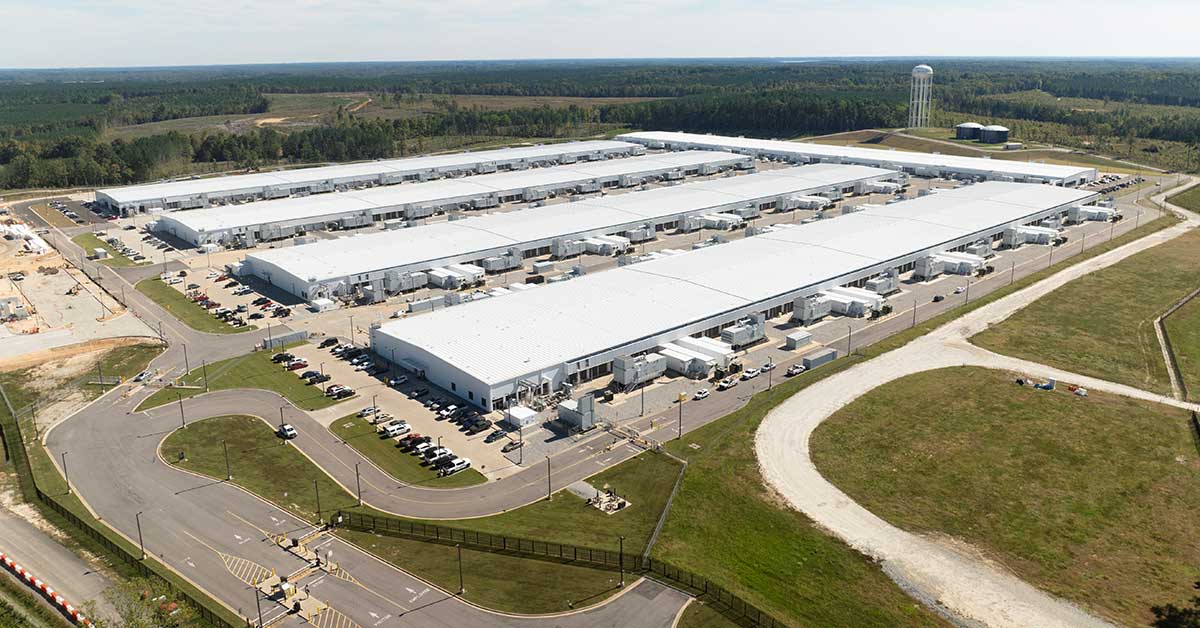
Northwest Indiana prime location for data centers, investment in future
Data centers mean big investments in the communities that approve them, but some residents have concerns — how much energy and water will data centers actually use?
One of the biggest proponents of data centers is Hobart Mayor Josh Huddlestun, whose city stands to gain big money from the Amazon Web Services data center to be built there.
“There’s a lot of myths around data centers, and they’re not the movie villain everyone portrays them to be,” Huddlestun said.
Data Center Map reports that more than 100 data centers are either planned or operating in Indiana, and Northwest and North Central Indiana will boast about 50 of them.
In 2024, data center operations supported 1,800 long-term jobs in Indiana, according to a fact sheet published by the University of Virginia’s Weldon Cooper Center for Policy Studies.
Huddlestun wanted to be sure that data centers were right for Hobart, so he and his team went to Loudon County, Virginia, which has a high concentration of data centers.
Huddlestun talked with Loudon County officials and residents to get their take on data centers’ impact on their lives.
“What we found out is not all data centers are built the same,” he said.
That gave Hobart leverage in negotiating with Amazon. Now the city is getting a windfall.
“The city of Hobart will receive about $200 million in the first three or four years and then $50 million a year after that,” Huddlestun said.
“We think over the course of the next 35 years, we’ll receive additional revenue of about $1.5 billion,” he said. And that’s on top of the property tax for the land and buildings and the personal property tax for the servers and other costly equipment at the data center campus.
Hobart’s tax base is roughly tripled. And despite a 2025 state law throttling property tax revenues for local government, a municipal income tax that otherwise would be a virtual necessity is unlikely to be adopted, economic development expert Matt Reardon said.
Reardon, founder of Hammond-based MCR Partners, said data centers are, per acre, “by far the most lucrative type of development I’ve ever seen with the least environmental drawbacks.”
Negotiating terms
Along with Northwest Indiana Forum President and CEO Heather Ennis and others, Reardon spoke at an April 16 public forum that drew a large crowd to the Lowell High School auditorium.
“Northwest Indiana obviously has been getting a lot of attention on data centers lately,” Ennis said. “Over the last three years, it’s kind of astronomical what’s coming down the pike.
“This rush will not last forever. There will be a saturation point where we build out the infrastructure that’s needed.”
Like Huddlestun, she noted the economic benefits to communities they locate in. For Hobart, getting money beyond what property taxes will generate means massive amounts available for public safety, park amenities and other quality-of-life improvements that otherwise would be difficult to fund so generously.
In La Porte, Mayor Tom Dermody negotiated terms for the $1.3 billion Microsoft data center going in there to include a massive amount for the school district as well as the city.
Data centers also enrich STEM partnerships. Companies building them have shown interest in partnering with communities to build the workforce, Ennis said.
“We’re at the next industrial revolution in technology, and we’re watching it unfold in real time,” Ennis said.
She encouraged people interested in data centers to check out NWIdatafacts.nwiforum.org, a website built by the Northwest Indiana Forum and partners to dispel myths.
Indiana Secretary of Energy and Natural Resources Suzanne Jaworowski spoke about data centers and utility needs. Data centers have a voracious appetite for electricity.
“This is the best step to take, to approach these opportunities with an open mind,” she said. “It’s a very tricky time for Indiana and our country.”
Energy sources have shifted during the last 20 years, she said, going from 90% coal to 49% coal and 43% natural gas now.
“These issues are really important to Americans because it affects affordability,” she said.
Twenty years ago, demand for electricity was stable. That was before data centers began to proliferate.
“Nobody really knows what our demand (for electricity) will be,” Jaworowski said.
“Data centers create demand,” as does bringing more manufacturing to the United States, she said.
“I’m not here to tell you you can’t have data centers,” Jaworowski said, noting that Gov. Mike Braun has said Indiana is open for business with data centers. “He is asking for data centers to pay their fair share” of the cost of additional electrical generating capacity, at least 80% of the energy infrastructure they need.
Jaworowski indicated that nuclear power is likely to have a comeback to supply electricity for data centers, but it takes a long time to get those permits in place.
“It’s time for us to stand back, take an inventory of what is happening,” she said, and make decisions with lots of information.
Attracted by water
Data centers can use a large quantity of water, too, to cool the servers, depending on the design chosen.
Sentinel Data Centers CEO Josh Rabina outlined the two types of cooling data centers can use. One is evaporating water out of cooling towers.
“It’s a little bit more efficient. It uses a little bit less power,” he said, but it can require a lot of water.
Air-cooled systems like the one proposed in Lowell use large HVAC equipment, typically mounted on the roof.
“That system uses zero water,” he said. “You’re discharging nothing,”
Huddlestun said Amazon’s plan to use 14 million gallons of water annually at the Hobart data center complex sounds high, but it’s less than the average golf course or 200 homes.
“A good portion of the year, they just open the windows and pull in outside air,” another reason to locate in Northwest Indiana, he said.
Kate Stoll, project director at the American Association for the Advancement of Science’s Center for Scientific Evidence and Public Issues, said the Great Lakes area is attractive to data centers. But it’s not the industry’s only target. Texas is the new Virginia, she said. “They’re actually slightly ahead of Virginia in terms of planned data centers.”
The Great Lakes have more than just a lot of water.
“The climate is cool in the winters, at least, so it’s a little easier to cool them there,” Stoll said.
In addition, Northwest Indiana is adjacent to a major urban area, offering fast data transfer and access to a skilled workforce.
Concerns
Proponents have a lot of ammo, but opponents aren’t without arrows in their quiver.
Opponents cite concerns about transparency, the amount of water and energy needed and noise from generators.
Transparency is an issue for data center operators because they’re so concerned about security, protecting equipment and data privacy alike.
“Security is definitely one of the concerns of data centers,” Stoll said. Physical security is required, but “cybersecurity is huge. The tech companies know how important cybersecurity is,” Stoll said. “If they get infiltrated, their business model is not going to go very well.”
“Everything is redundant systems with all these data centers,” to protect them.
A recent FBI report dealt with cyberattacks on critical infrastructure. “Water, power, all of these things are getting more and more hits,” Stoll said.
Data centers are needed for artificial intelligence as well as cloud storage, but data centers need advanced AI technology to thwart the advanced attacks that AI can facilitate. “Nobody doesn’t use AI for cybersecurity,” Stoll said.
Randy Palmateer, business manager for the Northwestern Indiana Building & Construction Trades Council, said data centers require generators for emergency backup power. The generators power up 30 minutes a month just to make sure they’re still operational, though they don’t have to all be powered up at the same time.
Palmateer is very familiar with generators. “All my union halls in the area have generators in case the power goes out,” he said.
Workforce needs
Palmateer said just building a large data center can take 2,000 or more construction workers. Once the data center opens, it needs not only programmers, custodians and security guards but also people to maintain basic systems like HVAC, power and more.
But Stoll said once data centers are built, few people are needed to maintain them.
“There was a lot of promise with jobs with data centers,” Stoll said, but they require few ongoing operational jobs once built. “That’s something that people have better understood recently.”
Technology is changing daily, so there are jobs out there to make changes all the time. “There’s a constant flow of building trades men and women going in and out of those facilities,” Palmateer said.
Building the electrical generation facilities takes even more workers, he said.
NIPSCO recently received preliminary approvals for a combined circle gas turbine project at the Shaffer Generating Station in Wheatfield. At its peak, 3,500 to 4,000 workers will be at that site, putting power on the grid to keep data centers running, Palmateer said.
The construction trades have enough workers for the proposed data centers and power plants because apprenticeships were increased an average of about 25% in anticipation of the massive hydrogen hub plant that would have been built in northern Lake County. President Donald Trump cancelled the next-generation energy project after taking office last year.
“We have the best industrial construction force in the country,” Palmateer said. “We do the most industrial manhours in the whole country.”
Palmateer said his members appreciate the jobs data centers offer, but they’re also citizens.
“We do not support data centers in places they don’t belong. Our members live in those communities,” he said.
The first data center Palmateer was involved with was the Digital Crossroads project at the old State Line Generating Station in Hamond. Tom Dakich, who built it, did it the right way, Palmateer said.
Dakich contacted the building trades, ensuring there would be a local workforce and a project labor agreement, while working simultaneously with Mayor Thomas McDermott Jr.
“He built the first successful data center in Northwest Indiana with no remonstrators,” Palmateer said. “Why everybody didn’t follow that footprint after that blew my mind.”
“Mayor Huddlestun has done a phenomenal job, and so has Mayor McDermott,” he said.
Next Merrillville
Palmateer also had kind words for Merrillville and Lake County, both of which have been proactive in developing zoning rules for data centers.
Merrillville Councilman Rick Bella is a driving force behind the Merrillville discussion.
Like Huddlestun, Bella decided a look at Loudon County was in order. “Why would you build a million-dollar house next to a data center?” he wondered.
Bella convinced the council to create a committee to study data centers. About a dozen people volunteered, so he put them all on the committee.
The town already has been approached for data centers in three locations — AmeriPlex at the Crossroads Business Park along Broadway and south of 93rd Avenue; Colorado Street and Harms Road; and 101st Avenue, east of Deep River.
Why those locations? Because they’ve got access to high-power NIPSCO lines underground, Bella said.
“They’re kind of circling and getting their ducks in a row. I think we’ll be approached very soon,” he said.
Bella’s hopeful that Merrillville will get the kind of investment Hobart is seeing.
“Hobart already got a check for $47 million. That’s way more than their entire budget for the year, almost double,” he said.
“It’s putting Lake County on the map in being leaders in this industry,” he said. “A lot of support businesses will come around because companies want to be around data centers,” just as happened with the steel industry.
“There’s a huge big picture here that a lot of people don’t look at,” Bella said.
Bella went to the data center at AmeriPlex in Portage. “It’s a small one, granted, it’s not a huge one there, but I couldn’t hear a thing” next to the fence, as far as he could go.
Opposition, Bella believes, is mainly just the unknown.
Taking land from farmers? Not an issue, he believes. “I see a lot of empty land all over that is not farmed.”
“Vertical farming is a thing now,” he added. Bella was in the produce and grocery business for decades.
Merrillville is partnering with the Northwest Indiana Forum to host a public event June 11 at the Dean and Barbara White Community Center to educate people about data centers. Participants will be able to visit various topic stations depending on their concerns.
“Really, Josh (Huddlestun) took all the arrows for us. I thank him all the time,” Bella said. •
Read more stories from the current issue of Northwest Indiana Business Magazine.

Flexibility for working mothers

Heroic values on display

One-stop print shop

Power of collaboration

Avoid the unexpected

Childcare challenge

Beyond the prescription pad

New life for dormant buildings

Banks keep branching out

Professional advancement

