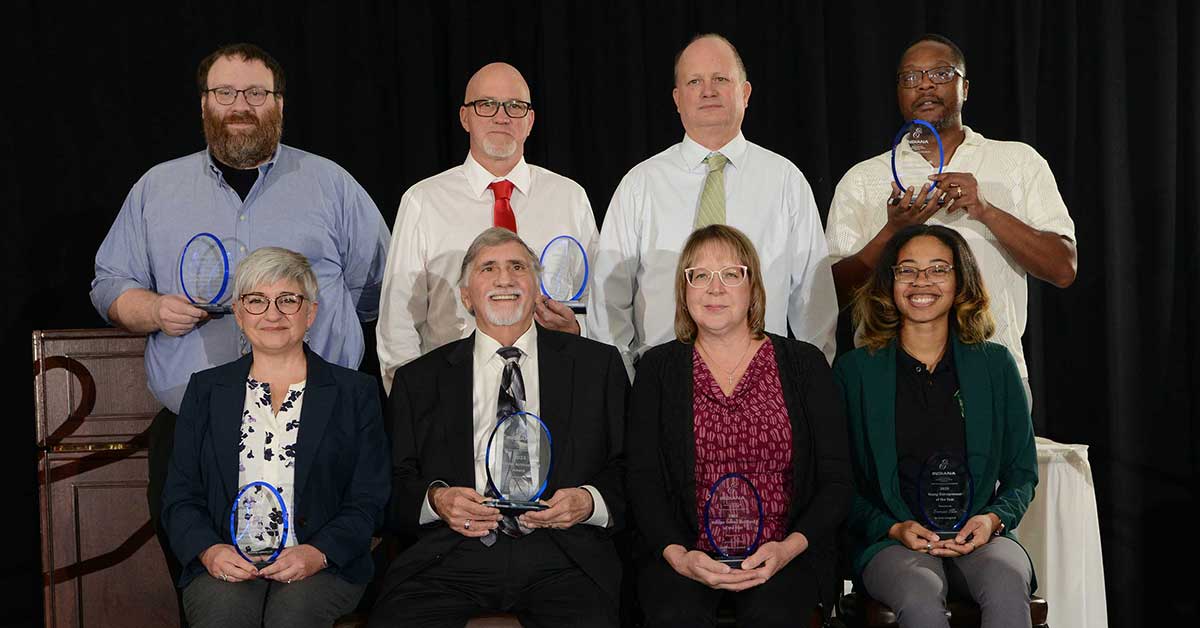
2025 E-Day award winners find fulfillment in helping younger generations succeed
Small business owners and their supporters tend to put their heads down and do their work, often for years and without any recognition. So, giving them some positive attention is a good thing, said Lorri Feldt, regional director of the Northwest Indiana Small Business Development Center.
Feldt said the Entrepreneurial Excellence Awards Day, or E-Day, is a celebration of those business owners and advocates and the countless ways they contribute to the Region.
“Certainly, seeing the room full of people and seeing them respond to the stories we’re going to tell, with the winners being appreciated, the winners are almost always surprised they’re being recognized,” Feldt said. “They’re not on the radar, typically, but it’s nice to feel appreciated.”
The NW-ISBDC started the E-Day tradition 34 years ago, well before Feldt joined the center, but she said the event is always a positive experience for her team.
“I think it’s really an opportunity for our team to step back and think about the importance of small business, the amazing (things) small businesses are doing, contributing to the Region and really sharing that with the community as a whole.”
Anyone can nominate a small business or a small business advocate for an award, but it’s a longstanding committee of business leaders, accountants, lawyers and others who pick the winners.
“Hats off to the committee members,” Feldt said. “Every year, when I look at the list of nominees, I know I would have such a hard time making such a choice. The committee always does such a great job making the right choice for that category.”
Small Business Advocate: Trudy Menke
Business coach and consultant Trudy Menke has earned an impressive array of certifications that she regularly uses to help business owners move to higher levels of success.
“There’s a lot of really great people out there doing really good work and assisting the cause of small business in Indiana,” said Menke, who founded Reframing Leadership. “I wanted to be able to create a toolbox of resources to help them.”
Until 2011, Menke worked in sales. Then, she became a founding member of famed motivational speaker John Maxwell’s coaching training certification program.
Menke began using Maxwell’s methods to build a list of clients, she continued her own training and added more certifications.
Two years later, she drew on her long list of business contacts and launched Reframing Leadership. Over the years, Menke signed up for training in leadership, strategic planning practices, working with different personality types and coaching skills.
Now, she pulls out tools to build up clients as they build up their businesses.
“Entrepreneurs can be all over the place,” Menke said. “Sometimes they need someone that points to best practices, leadership wise, communication wise, and asks good questions like any good coach. As a coach, you’re bringing ideas and helping them to think of ideas.”
Young Entrepreneur: Emmani Ellis
Emmani Ellis graduated from Purdue University with a degree in robotics engineering and landed an internship with Tesla. Then, she left it to invest in her hometown.
Ellis launched No Limit Living, a family business that is seeing neighborhoods profit from investing in communities.
“There’s a real opportunity to make real change here,” Ellis said of Northwest Indiana.
No Limit Living acquires properties, often from tax sales, rehabilitates them and offers them to people who otherwise might not be able to buy a home. The company partners with nonprofit organizations and with people in shelters and other transitional housing “to be a provider and make sure we help disadvantaged people with quality housing,” Ellis said.
Ellis said it’s not about snatching up properties and flipping them. The purchases must make good business sense while doing good things in a community.
“We’re not just going to fix and flip,” she said. “That’s not our goal. Our goal is to have housing and maintain housing, but if it doesn’t work, then we’ll sell the property.”
Ellis said her company also has launched a drone business to provide research and images to other real estate investors and developers, and they’ve stared a nonprofit to educate young people on real estate investing.
Ellis and her family started No Limit Living in 2022 and went all in last year, but she said it all became real to her while the business rehabbed a home in Gary’s Emerson neighborhood.
“I’m watching this neighborhood visually change form, going from half the street is abandoned to visually looking like this block had been restored,” she said. “I saw neighbors begin to take more action, walking around picking up trash. The conversations were about restoring and giving them back some hope.”
And, younger people started asking questions about reviving their own neighborhoods, Ellis said.
“So, it was really eye-opening that we’re changing the community, being a part of restoring it, but also there’s a demand for this education piece too,” she said. “There’s still a lot of work to do.”
Emerging Business: Joseph Podgorski
Joseph Podgorski, owner of Project R3D, started making custom 3D printers in 2017 because 3D printers were in a rut. They weren’t responsive to customers anymore; their speeds were stuck in low gear and there was little innovation.
The 3D printer manufacturing) companies that were out there weren’t pushing the boundaries, Podgorski, of DeMotte, said. “They got to the point where people were just getting interested, and then they stopped,” he said.
That need started Podgorski on course to build Project R3D, which makes and sells innovative 3D printers that are affordable and adaptable to customers’ needs.
Eight years later, he’s grown Project R3D into two companies that can build thousands of 3D printers every year.
Project R3D printers are being used in all kinds of applications: creatives in the “maker community,” a global network of tinkerers, designers and DIY enthusiasts; the automotive industry and car fans who want to make specific parts; and the U.S. military, which is one of his biggest clients.
Project R3D and its related company, Chicago Additive, which was launched in response to interest from the military, make three lines of printers — the Daedalus, the Talos and the Amos. They are drawing attention from around the world.
The printers run from as low as $2,000 each to more than $12,000 for the larger, industrial work horses, and the companies can make countless parts, depending on what customers want, Podgorski said.
“The goal has always been to be agile to what customers need,” he said.
The companies’ manufacturing lines can be quickly adapted to make newly designed parts, and Podgorski and his team can prototype parts and get them out the door in very little time.
For example, printer frames that once took Podgorski 90 minutes to make can now get knocked out in three to five minutes.
In 2023, the military came calling. The Naval Information Warfare Center Pacific contacted Podgorski about making specialized printers for the research facility. That led to the Amos line, which the military licensed to Project R3D in spring 2025.
Podgorski said taking a sensible approach and building printers that customers actually need, instead of building printers and expecting customers to adapt to them, is the way he built Project R3D.
“When all you have is a hammer, then every problem looks like a nail,” he said. “We need to make a printer to solve a specific need.”
Small Business Persons: Ryan and Chris Sandberg
John Sandberg opened a gas station and two-bay auto repair shop in Valparaiso in 1973.
More than 50 years later, Sandberg’s sons, Ryan and Chris Sandberg, who worked in the business for years before buying it eight years ago, oversee a fleet of 28 towing, recovery and delivery vehicles with nine employees and a 7.5-acre complex.
’Chris Ryan repeatedly spoke of the Sandberg family. Chris said he and his brother look forward to taking their sons, who also work for Sandberg’s Towing & Recovery, to the E-Day celebration.
“This business hasn’t been super predictable,” Chris said. “There’s been things we’ve missed, but over the years, we’ve finally gotten to the point where, to me, this award shows we’ve worked really hard to get to where we’re at. We’ve had to make a lot of sacrifices, and it’s paying off.
“For the third generation coming with us to the awards ceremony, I think it’ll be neat for them to see that.”
Another not-so-secret key to the Sandbergs’ success is helping people in need, said Chris Sandberg, who along with his brother, still answers calls for help day and night.
“Sometimes, people will call you in the middle of the night, and they will literally tell you, ‘You’re the fourth company I’ve called and everyone says they’re not available,’” he said. “I have three guys on call, so we’re always available.”
Chris Sandberg’s wife also works for the company. Generally, when someone calls Sandberg’s, a Sandberg is going to answer the call, he said.
Not every call is an emergency, Chris Sandberg said. Since adding large semi-trailers to the fleet, Sandberg’s Towing and Recovery has started picking up large equipment around the country for deliveries, and they also provide minor auto repairs in their shop.
Just as John Sandberg’s sons have expanded the business, Chris Sandberg said he hopes the next generation will eventually do the same.
Advocate for Youth Entrepreneurship: Antonio Conley
Antonio Conley knew he was on to something with his nonprofit BuddingPreneurs when his young clients, ages 7 to 16, braved a massive thunderstorm so they could keep selling their wares at a popular boat race in Michigan City.
“That’s when I knew I have to keep going forward and keep pushing forward with these kids,” Conley said.
BuddingPreneurs trains young people to develop their entrepreneurial instincts, Conley said. They meet with business owners, learn about personal and business finances, and pitch their own products in Michigan City’s monthly “First Friday” events.
“We give them an opportunity to see what it’s like to be an entrepreneur,” said Conley, who serves as president of the organization. “They interact with customers passing by. Parents can’t help them, and it’s been very, very successful.”
This year, BuddingPreneurs partnered with the Economic Development Corp. of Michigan City to hold the inaugural, four-week boot camp. Eleven local children learned how to start and run a business. There are plans to expand BuddingPreneurs to other cities around Indiana, and Conley said he wants to adapt and build up the boot camp.
The focus on young entrepreneurs came from Conley’s own journey, he said. As an 8-year-old in Minneapolis, Conley learned about entrepreneurship from a business owner, when he began helping the man care for his mother, who was Conley’s neighbor.
Later, Conley started a landscaping business before eventually opening up his own clothing boutique, selling items he’s designed, he said.
But, he kept returning to his younger days and thinking of ways to help young people feed their own entrepreneurial spark, Conley said.
“I was once one of the kids who needed someone to create a space or outlet where I could have free, open space to become an entrepreneur and people around me who were actual successful entrepreneurs,” he said. “Being that I needed that as a kid, I knew as an adult, I was going to create something like that for these kids.”
BuddingPreneurs sell their goods every week to local businesses and nonprofits. Several of them have sold bulk orders of their products from cookies to T-shirts to bracelets and more.
Teaching them about financial literacy is the most important lesson adults can share with kids, Conley said.
“There’s a huge percentage of people who don’t understand how finances work,” he added. “If you can teach them finances at a young age, you can give them a good head start.”
Woman-Owned Business: Carol Harsh
Carol Harsh left the corporate big box store world to deal in really small things: birds.
In 2015, after working as a manager and trainer in stores like Target, Dick’s Sporting Goods and Kohl’s, Harsh said she needed a change.
Harsh stumbled upon Wild Birds Unlimited, a national brand with 360 stores and a franchise opportunity.
Harsh and her husband opened their first franchise store in Schererville in 2015 and their second in July 2025.
“My husband and I were done with the big corporate world, and we started looking into things that were available to do,” she said. “I’ve always loved birds since I was a little girl, logging them down into my little bird book.”
Harsh said she didn’t know many women business owners growing up, but she knew plenty of strong women. Now, she thinks often about helping a younger generation of women find their way in business, which includes hiring a 21-year-old woman to manage the Crown Point store.
“One of the things I always enjoyed doing as a manager was helping develop others,” Harsh said. “As my career grew, I’ve always gotten a lot of enjoyment on helping others and hoping I could have an impact on them.”
Harsh also recommended anyone interested in starting their own business should think about the diversity of their prospective employees.
“Work hard, trust in others, and you’re going to get out what you put in,” Harsh said “Surround yourself with strong people and have a diverse group of individuals with different strengths.”
Lifetime Achievement: Ross Pangere
Ross Pangere has spent decades building massive structures all over Northwest Indiana and the Midwest, but he was quick to praise others when he discussed winning the Lifetime Achievement Award.
“It’s hard for me to fathom even getting this award to be honest,” Pangere said. “You just go day by day and try to do a great job for your clients. I try to make sure my associates are well taken care of. They do a great job, they work hard. They’re the ones who have made this company what it is today.”
A Gary native, Pangere left the Pangere Corp., a 120-year-old family business, in 1994 to start The Ross Group, which provides design and building, roofing and metal siding services.
He had three employees back then. Now, The Ross Group has 12 full-time employees and hires engineers and union trades workers by the dozens — sometimes as many as 100 workers — for a range of construction projects.
“I brought in some of the most intelligent, best people in the industry to help make this company successful,” he said. “I don’t think there’s any time of building that we haven’t really been involved in.”
Pangere also credited his wife, Lexi, for her support, and he said they are very involved with community groups, from helping visually impaired people to fundraising and scholarships.
“We’re pretty benevolent in that regard,” he said. “We’ve given quite a bit to help various groups in the community.”
Pangere offered several tips for younger people who want to succeed in any kind of business.
“First and foremost, you have to be honest. You have to be sincere. You have to be hard-working. You have to be dedicated.” •
Read more stories from the current issue of Northwest Indiana Business Magazine.
One step at a time
Region on prosperous path
Paladin’s dream hub

Making surgery safer
Support for big ideas

A value-added food chain
Change for the better

New medical partner

Economic foresight
Professional advancement