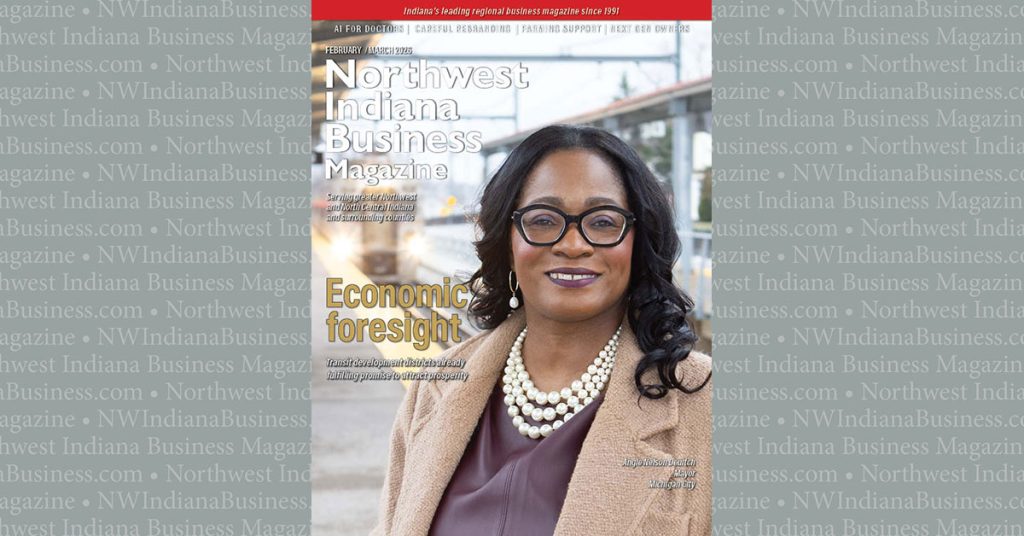
Transit development districts already fulfilling promise to attract prosperity
When you invest $1.5 billion, you want a solid return on that investment. Transit development districts set up by the Indiana General Assembly are the state’s way of making sure the money spent to expand passenger rail service in Northwest Indiana brings those many happy returns.
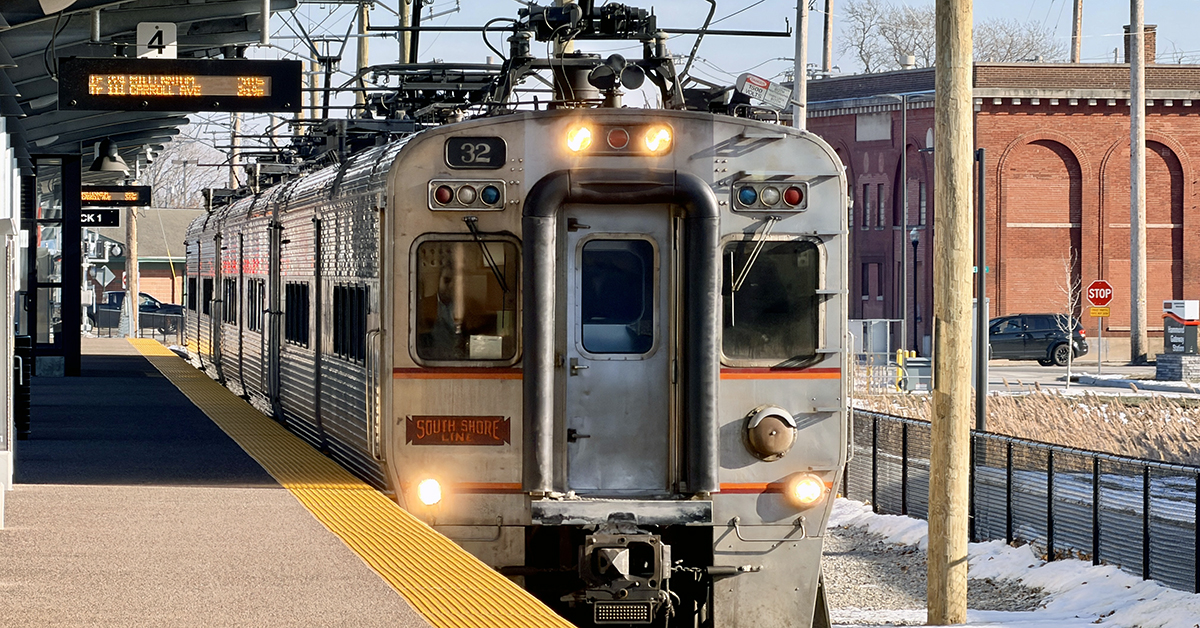
The Double Track Northwest Indiana project that added a second set of tracks between Gary and Michigan City has allowed more trains, making Michigan City an easy commute. Operations began on that expanded system in May 2024.
Service is expected to begin on the new north-south route between Hammond and Dyer in March. That’s the long-awaited West Lake Corridor project that has been talked about for decades. The extension officially was renamed the Monon Corridor late last summer.
The Northern Indiana Commuter Transportation District, which operates the South Shore Line, and the Northwest Indiana Regional Development Authority predicted that within 20 years $1.5 billion combined investment for expanding commuter rail service would attract at least $2.5 billion in private investment within those transit development districts.
“My view is that $2.7 billion is a very conservative investment,” said NICTD President and General Manager Michael Noland. “I am bullish on the transit-oriented development side, the private sector investment side.”
So far, more than $700 million worth of projects have been either started or announced, even before completion of the West Lake Corridor project, RDA President and CEO Sherri Ziller said.
“We’re ahead of our projections, and we’re not seeing it slowing down,” she said.
Already, the massive investment is paying dividends.
“The first people in, they’re the biggest risk-takers,” Noland said. “They see the value. They see the vision.”
Michigan City and Hammond are the poster children for how these transit development districts work here.
Hammond focuses on downtown
In downtown Hammond, The Banc project converted the former Calumet National Bank building into residences. The residents’ incomes are providing seed money for that TDD’s investments.
“Their leasing rate was fast and swift and surprised us and surprised the developer,” said Anne Taylor, the city’s executive director of planning and development.
The Banc, at the corner of Fayette Street and Hohman Avenue, is near the new station Hammond wants to build for the Monon Corridor route.
“We are ready. We have the design. We have sent out bids to the contractors,” Taylor said.
Construction of the new station must wait until ridership starts because it wasn’t included in the original plan.
The West Lake Corridor plan was all set to go before Hammond proposed building the station, Noland said. Revising the plan to include the station would have delayed the entire project by at least a year. Instead, the elevation of the rail lines was calculated to anticipate the station being built between Douglas and Russell streets, near the federal courthouse.
The Banc fits in with the downtown master plan created by consultant Jeff Speck, a famous urban planner based in Arizona.
The 149 residents The Banc brought to downtown Hammond are pioneers helping spur a population increase there.
“The vision that was brought to us by Jeff and what we’re holding onto is having people in our downtown,” Taylor said.
The city originally focused on bringing businesses downtown.
“Jeff really talked about bringing the people downtown and the businesses will follow,” Taylor said. “It’s just an amazing location. People are coming; people are wanting to come.”
Developers are looking at vacant lots and buildings to rehabilitate.
“We’re getting people living in our downtown who have never lived in our downtown before,” Taylor said.
Hammond has another TDD surrounding the south Hammond station. Where the northern TDD is going gangbusters, the southern one is trickier. The station there is in an established neighborhood, so development likely will come in smaller pieces to not disturb the neighborhood’s character. Places like coffee shops and restaurants are more likely, serving residents as well as riders, Taylor said.
Michigan City — risk worth taking
In Michigan City, it’s easy to see the impact of the TDD. The new station on 11th Street is dwarfed by a large mixed-use building that is mostly residential but will have commercial space on the first floor. Clarence Hulse, executive director of the Economic Development Corp. Michigan City, hopes a 6,000-square-foot restaurant will occupy the commercial space.
The train station opened last summer, along with the adjoining parking garage to be shared by residents, riders and shoppers. The $100 million-plus development by Flaherty & Collins is in the construction stage.
Hulse met with the developer late last year and learned it’s the hottest property in Flaherty & Collins’ portfolio, with 114 active inquiries for the 220 apartments long before they’re completed. It’s rare to get so many inquiries this far in advance, Hulse said.
“Local people are like, why are we building this?” Hulse said, but he expects a number of locals to move in.
The downtown amenities make it a good choice for people who are downsizing, Mayor Angie Nelson Deuitch said.
“We knew it was risky. We knew what we wanted to do, and all the pieces fell into place even though people didn’t think it would,” she said. “I think we were all hesitant and scared at the same time.”
The parking garage was planned as part of the new train station when Nelson Deuitch joined the Redevelopment Commission in 2020.
“We decided we wanted something bigger and better than a parking garage,” she said.
The parking garage had already been out for bids and a contract awarded, Planning and Redevelopment Director Skyler York said. “We reserved this little space which we never would have built on.”
Nelson Deuitch, City Council president before being elected mayor in 2023, succeeded in getting a new request for proposals and rebidding the project to include a mixed-use development as well as a parking garage.
“We felt as a TDD aspect we could be bigger and better,” she said.
The Northwest Indiana Forum organized trips to see Naperville, Illinois, and other places where transit-oriented development has paid off.
“I saw that this could be transformative by having retail, housing at the train station,” Nelson Deuitch said.
“That pivot in 2021 is why we’re here today and why other businesses are opening. I don’t think the parking garage would have spurred this development.”
“It changed the trajectory of our downtown and that district,” she said.
Nelson Deuitch and Hammond Mayor Thomas McDermott Jr. talk on a regular basis.
“He’s like, I want what you’ve got,” she said. “People are starting to bet on Michigan City, and I think it’s because of that hard stop and hard pivot that we made.”
Michelle Dickman, co-owner of The Brew Box, is among the people betting on the city’s downtown. “I just kept saying this would be a perfect spot for a coffee shop because it’s right by the station.”
In October 2023, she and her partners began gutting the former M&M Diner just north of the Flaherty & Collins development. The Redevelopment Commission agreed to a $40,000 grant, more than it normally would have offered, because the building was in such bad shape after being vacant for more than 20 years.
“It was kind of run down to say the least,” Dickman said. “We’re in a historic district, so they wouldn’t allow me to tear down and build again.”
The exterior retains the 1950s look while the interior offers a modern coffee shop vibe. The Brew Box began a soft opening in late November.
Riders stream by and drop in for a coffee or tea and pastry. “We get a lot of the workers, too,” she said. “People now have somewhere to hang out.”
The Brew Box has a location in Hammond, too, just two blocks from a station.
“We would love to get in other locations that are close to the train,” she said. “It would be great to be up and down the whole train line, but in time.”
Gary cleaning up first
Among the possibilities for another Brew Box location would be Gary, which, like Hammond, has two TDDs surrounding the Miller and downtown Gary Metro stations.
The Gary Metro station is due for a replacement. Mayor Eddie Melton describes it as having riders go through hamster tubes to get from one place to another in the station.
What the new station will look like remains to be seen. AJ Bytnar, the RDA’s economic development director, said it could be multimodal — it now serves Gary Public Transportation Corp.’s buses as well as the South Shore Line’s trains — and it could have a residential component like Michigan City’s station.
Getting the Gary Metro Center board put together and analyzing the potential will determine what can and will happen.
Melton, who serves on the NICTD board, is focused on improving the downtown and bringing people back there.
“You have to clean up your house before you invite in guests,” said Christopher Harris, the city’s executive director of redevelopment.
Melton’s first year and a half in office were devoted to doing just that — addressing public safety, neighborhood issues and achieving the city’s first budget surplus in decades.
Razing vacant buildings is vital, too. The city and the state have spent millions of dollars clearing out properties to make the city more attractive to developers. An estimated $80 million will be needed to address the rest of them, Melton said. Contractors like Rieth-Riley and Hasse Construction have volunteered their time, but it still costs the city to dispose of the building materials.
A $15 million Lilly Endowment Inc. grant through the state’s Regional Economic Acceleration and Development Initiative 2.0 program will help pay for demolition.
“They want to further invest in areas that they can see investment taking place,” Melton said.
Harris said it’s paying off. When people come to Gary to film examples of blight, they’re moving further from downtown to find it, he said.
“We’re going to be telling our story as the greatest comeback city in American history,” Melton said. “I believe it. I truly believe it.”
“Our population is growing for the first time in 50 years.”
And with the Nippon-U.S. Steel deal, Melton was able to get national attention for Gary.
“Our team, we brought 2,000 jobs to the city in the last year and a half,” Harris said.
Near the Miller station, in the Aetna part of the TDD, 45 single-family homes are being built. A 60-unit structure is planned on south Lake Street. Homes are being built with price points in the $450,000s, Melton said.
“This is something new for the Miller, Lake Street corridor,” he said. “Those permits are already in review.”
Commercial properties are under contract for potential mixed-use development. “It’s just happening organically,” he said.
“We understand that Miller is really nestled along Indiana Dunes National Park,” Melton said.
The Paul H. Douglas Environmental Education Center is in Miller, and the Marquette Greenway runs through the park.
For the downtown, Melton has big plans. He’s working with the Indiana Department of Transportation to get truck traffic off Fourth and Fifth avenues so they can become more walkable. He brought festivals and food trucks and other events downtown to get people back in the habit of visiting downtown Gary.
He’s looking at paving streets, repairing sidewalks and more to show investors the city is putting skin in the game.
“Everybody’s wondering who’s going to be the first” developer to recognize the potential and invest downtown, Melton said.
Portage potential
One of the TDDs looking for those risk-takers is Portage, where the TDD encompasses land south of the Portage/Ogden Dunes station.
Consultant Aaron Kowalski of MKSK, who has been working with the RDA to get these TDDs up and running, sees great potential there.
The city is promoting the potential for a lodge to serve Indiana Dunes National Park’s overnight guests as well as commercial and residential development near the station. Burns Parkway will be extended, as will the Marquette Greenway for a walkable development.
World’s Finest Chocolate has expressed interest in building a plant in that area, he said, which adds to the TDD’s economic development potential.
Another TDD, created in 2025, encompasses the Beverly Shores train station and extends into The Pines, the tiny town to the immediate east. That linear TDD isn’t expected to accomplish much until a sewer line is extended east from Michigan City to serve the U.S. 12 corridor through those two towns.
The sewer line will make development feasible along the highway, long envisioned as becoming a scenic byway devoid of truck traffic. The RDA’s new 20-year master plan includes supporting the designation of the road as a scenic byway and extending sewers to lakefront communities to reduce the environmental problems that failed septic systems can cause.
That improves the quality of life as well as the economy, including tourism.
The Dune Park TDD has great potential, Kowalski believes, particularly because the town of Porter just drafted a new comprehensive plan that includes that area.
The Ridge Road TDD in Munster is designed to support neighborhoods and see more economic development and vibrancy, he said.
The Main Street station, in Munster/Dyer could draw riders from across the state line, which could bring their spending to Indiana, Kowalski said.
“We crafted these boundaries in such a way as to consider what communities want to consider,” he said.
Already thinking bigger
The TDDs can be expanded one time, doubling their size to 640 acres. Bytnar said some of the communities have already begun talking about that option, but the RDA is more concerned about maximizing the potential for economic development within the existing boundaries.
The TDDs promise to be a transformational concept for Northwest Indiana.
“We’re uniquely situated out of all the regions in the state because we sit next to the third-largest economy in the nation — Chicago,” Ziller said.
The Chicago region has more jobs than the entire state of Indiana, with 4.5 million jobs in the Chicago metropolitan statistical area compared to 2.9 million in Indiana, she said.
The RDA has done heavy lifting for some major projects in its 20-year history, not the least of which was assembling the capital stack for the $1.5 billion passenger rail expansion.
“The short-term play was to get people from Northwest Indiana to and from jobs in Chicago,” Ziller said. “The long-term play was always ‘how do we get those jobs here in Northwest Indiana.’”
That’s the TDDs’ purpose.
“A lot of folks are talking about where did we get this idea, where did it come from,” Ziller said. “This is something that we kind of came up with here in Indiana. It’s interesting. It’s capturing people’s attention. It’s innovative.”
Noland, who is retiring from NICTD this year, came from the Metra system in Illinois, where transit-oriented developments “were up and running all over the place.” He already knew their potential for Northwest Indiana.
“That concept was foreign to many of the local communities,” he said.
People were saying the railroad had been around for a century, and they weren’t seeing the developments Noland and other boosters were touting.
“TDDs don’t just happen. You don’t just sit back and hope they happen. You’ve got to market your community,” he said. “It went from a very misunderstood process to seeing communities up and down the rail line actively engaged. •
Tell our editor about TDD-related development in your community by emailing news@nwindianabusiness.com.
Read more stories from the current issue of Northwest Indiana Business Magazine.

One step at a time
Region on prosperous path

Paladin’s dream hub

Making surgery safer
Support for big ideas

A value-added food chain
Change for the better
New medical partner

Professional advancement